April 17, 2025 marks the eighth anniversary of Concerning History! In our long-running tradition, our contributors reflect on some of the other major historical anniversaries of the year. One post can only discuss so many events, of course, so if we missed anything, please add to the conversation below!
In a slight change from our usual approach, there is a major anniversary in 2025 that we are intentionally not highlighting here. 250 years ago this year, the American Revolution began with the battles of Lexington and Concord just outside Boston. We’ve already discussed some of the events leading up to that flashpoint in last year’s post, and this was such a huge moment in American history that we feel it needs no further publicity from us here—though we may very well engage with it in its own right later in the year!
1925: The Consolidation of Fascist Italy
Bryan Caswell
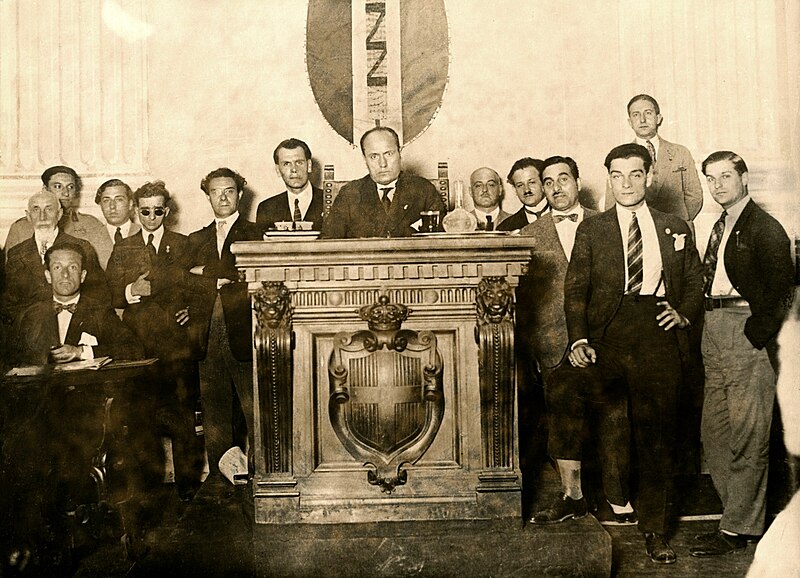
The inauguration and subsequent actions of the Trump administration this year have occasioned a whole range of articles discussing the rise of fascism and dismantling of democracy in 1930s Germany, but there is in fact a slightly earlier example. One hundred years ago this year, Benito Mussolini—Europe’s original fascist—consolidated his hold on Italy and transitioned from Prime Minister to full dictator. Fueled by anger at not receiving all of their grandiose territorial claims after the Great War, dreams of Roman irredentism, and hatred of Communists and other progressive opponents, Mussolini’s Black Shirts had marched on Rome in 1922 to demand the resignation of then-Prime Minister Luigi Facta. Facta’s efforts to declare martial law and call the army out against the fascist paramilitaries were not supported by King Victor Emmanuel III, and after Facta’s resignation and political wrangling in the cabinet, Mussolini ascended to the premiership. 1923 saw the passage of the Acerbo Law, giving the fascists a majority in Parliament no matter what percentage of votes they would receive. Finally, in 1925, Mussolini proceeded to finalize his coup d’etat, declaring himself dictator in an address to the Chamber of Deputies on January 3 (taking on the now-famous title of “Il Duce”). At the end of the year, the Decree of the Powers of the Head of Government made this arrangement formal, declaring that Mussolini did not answer to Parliament and no legislation could be placed before Parliament without his approval. It would be another decade before Italy would invade Ethiopia and another four years after that until the Second World War, but already the world order established at Versailles was beginning to crumble as nations sought alternatives to liberal democracy.
Recommended Reading: The Vanquished: Why the First World War Failed to End, by Robert Gerwarth
1950: Senator Joseph McCarthy Announces that Communists Had Infiltrated the US State Department
Francis Butler
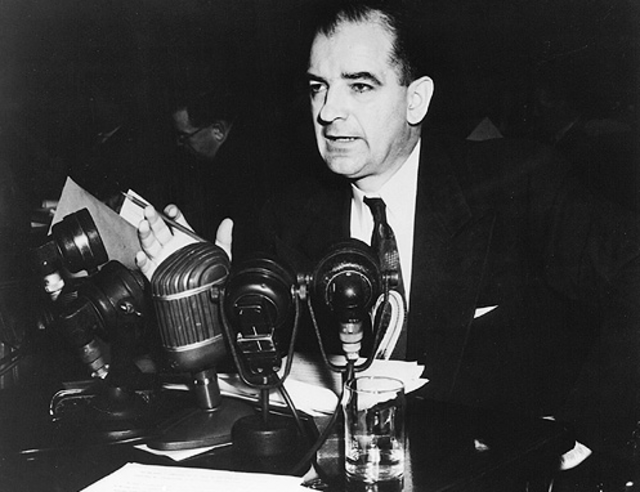
One of the pillars of the U.S. political system is the freedom of political expression afforded to all those in the United States. During times of national crisis, however, the U.S. government has sought to silence dissent or oppositional political speech and activity in the name of national security. Sometimes, this has been warranted. Other times, it has not been necessary. Frustratingly, these events never offer much clarity as they occur. As the Cold War heated up in earnest, the US faced the reality that its foreign policy in China had failed and entered into armed conflict with Communists in Korea that same year, the USSR had isolated Eastern Europe from US influence, and Soviet spies had successfully infiltrated and delivered U.S. nuclear secrets to the USSR, incentivizing a new phase of the Cold War with the arms race. Such developments alarmed U.S. policymakers, elected officials, and the American public, setting up the perfect situation for a demagogue like Wisconsin Senator Joseph McCarthy to exploit.
Wielding what he labeled as a list of State Department officials who all were part of the Communist Party, McCarthy led investigations into numerous Americans in the U.S. government, the military, in academia, and even in Hollywood whom he claimed were coordinating with Soviet Communism and threatening to sell America’s secrets or undermine its missions. Those accused faced severe reputational damage and often lost their jobs, job opportunities, and interpersonal relationships. McCarthy’s campaign to identify Communists in the U.S. government and society even sparked a simultaneous “Lavender Scare” within the U.S. government in which any employee suspected of or known to be homosexual faced dismissal because their same-sex relationships were viewed as an unacceptable liability that made them vulnerable to blackmail. Some Americans investigated in McCarthy’s inquisitorial crusade were deported while others were fired and alienated. Most famously, J. Robert Oppenheimer, the lead scientist of the Los Alamos project to develop the atomic bomb, lost his security clearance due to his contact with Communist sympathizers before World War II even though he never revealed or sold U.S. secrets to the Soviet Union. Strikingly, McCarthy’s most public opposition came in the form of Maine Republican Senator Margaret Chase Smith whose speech condemning McCarthy’s tactics and lack of evidence sought to defend the rule of law, free speech, and those accused of Communist sympathy right to due process. While McCarthy eventually revealed himself to be an incompetent bully with a penchant for alcohol, the entire episode served as a warning about the ways that a real threat to the United States can lead to mass hysteria and government overreach. There is no easy answer for how the government should balance the public interest to defend the U.S. from foreign and domestic enemies with the rights even of radical dissenters. Yet, the McCarthy Era hopefully provides clues to us about what not to do: accuse people of treason without substantive evidence and deprive them of their livelihoods, lives, liberty, or property without the due process of law.
Recommended Reading: Many are the Crimes: McCarthyism in America, by Ellen Shrecker
1925: The Tri-State Tornado
Heather Clancy
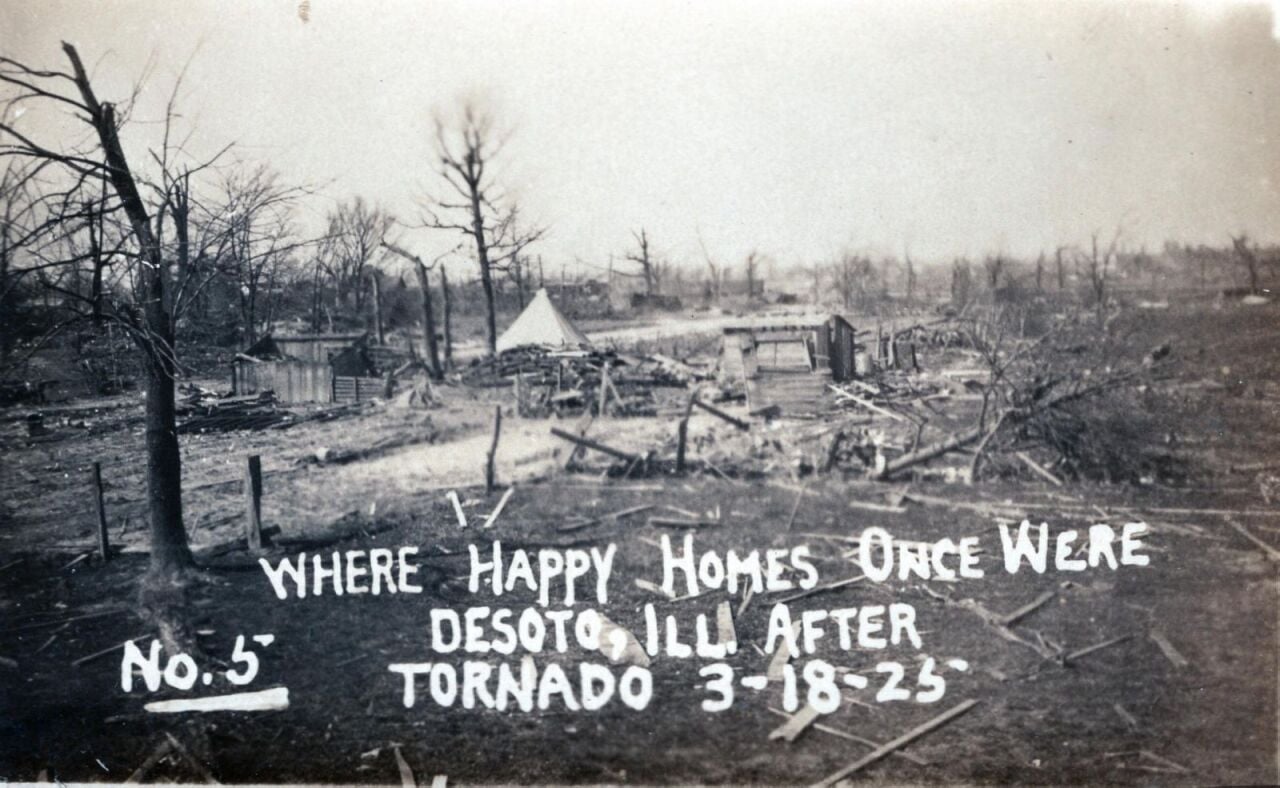
For as long as Homo sapiens have walked the Earth, storms have shaped the story of our species. Over 315,000 years, dark clouds have heralded both prosperity and ruin, humbling us time and time again. And every once in a while, a Big One comes along. One that’s so horrifically destructive, it sparks a new wave of technological advancement to better protect us from destruction. The Tri-State Tornado of March 18, 1925, was a Big One. Spawned around 1:00 PM near Ellington, Missouri, it was an unprecedented monster of a storm. Although it predated the Enhanced Fujita (EF) Scale by half a century, experts suspect it would meet EF-5 criteria—the highest possible rating. On an otherwise ordinary Wednesday, this devastating twister barreled through Missouri, Illinois, and Indiana, setting American tornado records still held today. Its duration (3.5 hours), damage path length (219 miles), and human fatalities count (695) all dwarf the stats of typical tornados, which travel 1–2 miles in 5–10 minutes, taking 0-1 lives. A meteorological behemoth, the storm became a powerful turning point in the nation’s tornado preparedness. In the decades that followed, tornado deaths per million Americans fell dramatically. Contributing to the decline were tornado warning innovations and a growing public awareness of tornado risks and precautions. Even since the 1996 film Twister (which celebrates its thirtieth production anniversary this year), there have been game-changing advancements.
The only problem? We’re fighting an uphill battle. The annual tornado count is climbing. Scientists suspect it may be one of the many symptoms of human-exacerbated climate change. In 2024, the NOAA counted 1,796 tornados, the second-highest figure since they started keeping records in 1950. So far for 2025, we’re pacing about the same at 526 preliminary reports. Scientists aren’t sure how tornadic behavior may change as climate change progresses. We may have fewer but more violent tornadoes. Tornado Alley may continue its slow creep eastward. Or tornados may surprise us with a completely unforeseen change to reshape the next chapter of human history.
Recommended Reading: America’s Deadliest Twister: The Tri-State Tornado of 1925, by Geoff Partlow & The Great Tri-State Tornado, by Justin Harter
1975: The Fall of Saigon
Francis Butler
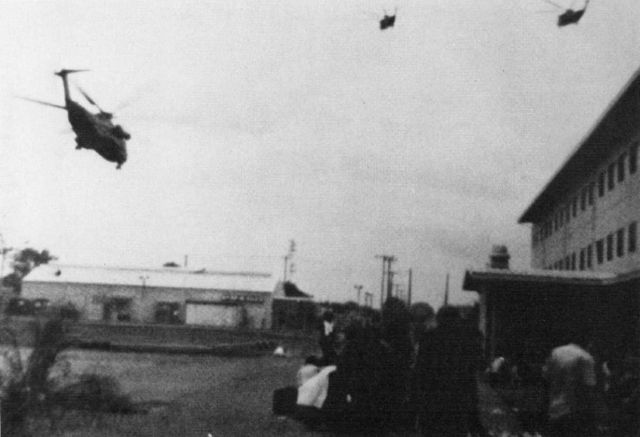
Regular readers of Concerning History will note that I have authored several posts about the Vietnam War. While I have not reached the culmination of the war in my posts, this year does mark the 50th anniversary of the Fall of Saigon to North Vietnamese military forces. As Richard Nixon started his second term in 1973, it was apparent to many US leaders in the State Department, the National Security Administration, and the Pentagon that the United States could not achieve its long term objective to create a self-sufficient, non-Communist South Vietnamese state. Consequently, leading diplomats such as Henry Kissinger, President Nixon, and their advisors sought to negotiate an end to the Vietnam War that would at least stave off a North Vietnamese conquest of South Vietnam for a “decent interval” so that the U.S. would not be seen as weak, inept, or apathetic towards the plight of its Cold War allies. To that end, the US negotiated the Paris Peace Accords, efforts that basically ignored South Vietnam’s concerns while also burgeoning the South Vietnamese military. However, once the US military presence in South Vietnam officially ended and the US left behind only advisors, the CIA, and State Department officials, the North Vietnamese launched a full scale campaign to conquer South Vietnam in March 1975.
On paper, the South Vietnamese military (ARVN) was a formidable foe. Though armed with the best weapons the US had to offer, several hundred thousand active duty troops, and a great deal of combat experience alongside the American forces, the ARVN was a paper tiger. Corruption and low morale ran rampant in the ranks and the few elite, cohesive units that functioned in the ARVN failed to operate effectively because they did not have proper support. The initial North Vietnamese offensive captured key strategic points in the central highlands and then swept south towards Saigon. ARVN resistance disintegrated and the U.S. had to execute a hasty and risky retreat of ARVN, US, and South Vietnamese personnel because US Ambassador Graham Martin obstinately refused to initiate withdrawal orders before North Vietnamese troops were about to enter Saigon. Once the North Vietnamese military overtook the city, thousands of ARVN troops were captured. The North Vietnamese regime systematically established re-education camps to harass South Vietnamese people into adhering to the North’s Communist Party doctrine while others joined the stream of refugees fleeing the Communist regimes in Laos and Cambodia. Rather than halt the spread of Communism, US intervention in Vietnam indirectly bolstered Communist movements in Cambodia and Laos and lost its bet on South Vietnam. In fact, even Kissinger’s hope for a “decent interval” failed as South Vietnam fell in a matter of months after the US withdrawal. This debacle raised questions about where the US ought to invest its resources in combating Communism and echoed into the contemporary present as the U.S. has lost two wars combating hostile regimes in Afghanistan and Iraq in the last two decades.
Recommended Reading: Black April: The Fall of South Vietnam, 1973-75, by George Feith