In the seventh installment of his series highlighting some of the worst-reasoned Supreme Court decisions in American history, Bryan examines how original intent (and sexism) was used to deny the plain language of the Constitution as written, and forced women to wait another half century before they could participate in society as full citizens.
In 1920, the 19th Amendment to the United States Constitution finally enshrined the right of women to vote. More specifically, it prevented any state from denying the right to vote to any citizen based on considerations of gender. At one stroke, the American electorate was doubled—or was it? Could it be that the 19th Amendment only confirmed a right which women had held for the previous fifty years? Should we in fact look upon the 15th Amendment, passed in 1870 primarily to secure newly freed Black citizens’ voting rights, as what should have been the arrival of women’s suffrage as well?
Such was the argument that early feminist and controversial public figure Victoria Woodhull made when she became the first woman to testify before Congress in 1871, for the House Judiciary Committee. While other suffragists like Susan B. Anthony and Elizabeth Cady Stanton sought legislative change from a present where women were assumed to have no political rights, Woodhull defiantly and provocatively declared the opposite: if 1868’s 14th Amendment had provided that “all persons born or naturalized in the United States, and subject to the jurisdiction thereof, are citizens of the United States and of the State wherein they reside” and that those citizens could not be deprived of their privileges, immunities, or the equal protection of that law, and if 1870’s 15th Amendment had referred to “the right of citizens to vote” in precluding the abridgement of that right on account of race, then women could most certainly vote without any further action! The logic of these two amendments seemed to require one of only two possible outcomes: either women were citizens, and thus could vote, or women could not vote, and thus were not citizens of the United States, as Woodhull asserted in her testimony before Congress.
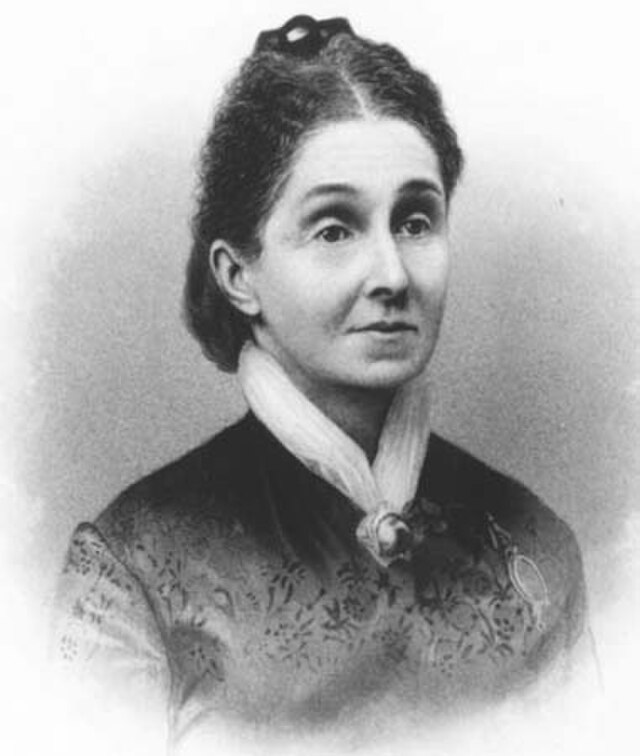
That same year, a Missouri woman named Virginia Minor turned Woodhull’s words into concrete action. Missouri’s state constitution explicitly denied women the right to vote, and so when Minor attempted to register to vote, she was turned away. With the help of her lawyer husband, Minor then sued on the grounds that Missouri’s constitution violated the 14th and 15th Amendments. Perhaps unsurprisingly, the Missouri Supreme Court ruled against Minor, and four years later, in 1875, her appeal reached the Supreme Court. Unfortunately for Minor (and Woodhull), the Court’s ruling would lead to the necessity for a separate Constitutional amendment decades hence.
In a unanimous decision written by Chief Justice Morrison Waite, the justices denied Woodhull’s logic and presented their own mix of original-intent oracular interpretation and hair-splitting technicality that bordered on sophistry. Even though the 15th Amendment refers to citizens’ right to vote, the justices confined their inquiry to the 14th Amendment, interrogating whether suffrage was automatically included in the “privileges and immunities” of citizenship. As the Constitution does not explicitly say that citizenship inherently entails the right to vote, in fact delegating voting policy and registration to the states, Waite asserted that it was up to those states to determine what privileges and immunities to bestow within their own boundaries. The Missouri constitution was thus perfectly legal and in accordance with the Reconstruction amendments. In a conclusion that both deified the competence of the Founders and ignored that those same amendments should materially impact any future interpretation of the Constitution, Waite alleged that “it cannot for a moment be doubted that if it had been intended to make all citizens of the United States voters, the framers of the Constitution would not have left it to implication. So important a change in the condition of citizenship as it actually existed, if intended, would have been expressly declared.” Thus, asked to rule on whether the force of textual logic and political justice gave women the right to vote as citizens, Waite declared that simply because the country had for decades already considered some individuals, including women, citizens without granting them the same array of rights as other citizens that it was fine to continue the practice. He declined to explain how a country that was founded upon the imperative of the consent of the governed could justify holding one half of its citizens as bound by laws they had no say in—indeed, one can equally argue that if a principle such as citizen suffrage was obvious enough to the Founders, they may not have felt the need to ever explicitly state it.
Perhaps it is for the best, or at least a silver lining, that this opinion in Minor v. Happersett occasioned a separate amendment, so that when it did arrive women’s suffrage could no longer be denied or papered over. It still ranks as one of the worse-reasoned Supreme Court rulings in history, however, demonstrating the all-too common tyranny of precedent alongside how the logical fallacy of the “original intent” of the Founders is in fact a meaningless cipher that can be used to justify nearly any legal argument an individual prefers. We can only be grateful that the later jurisprudence of the 1960s and ‘70s reversed this understanding of the “privilege” of suffrage; I can only hope voting rights for all citizens can survive the next few years, as well.