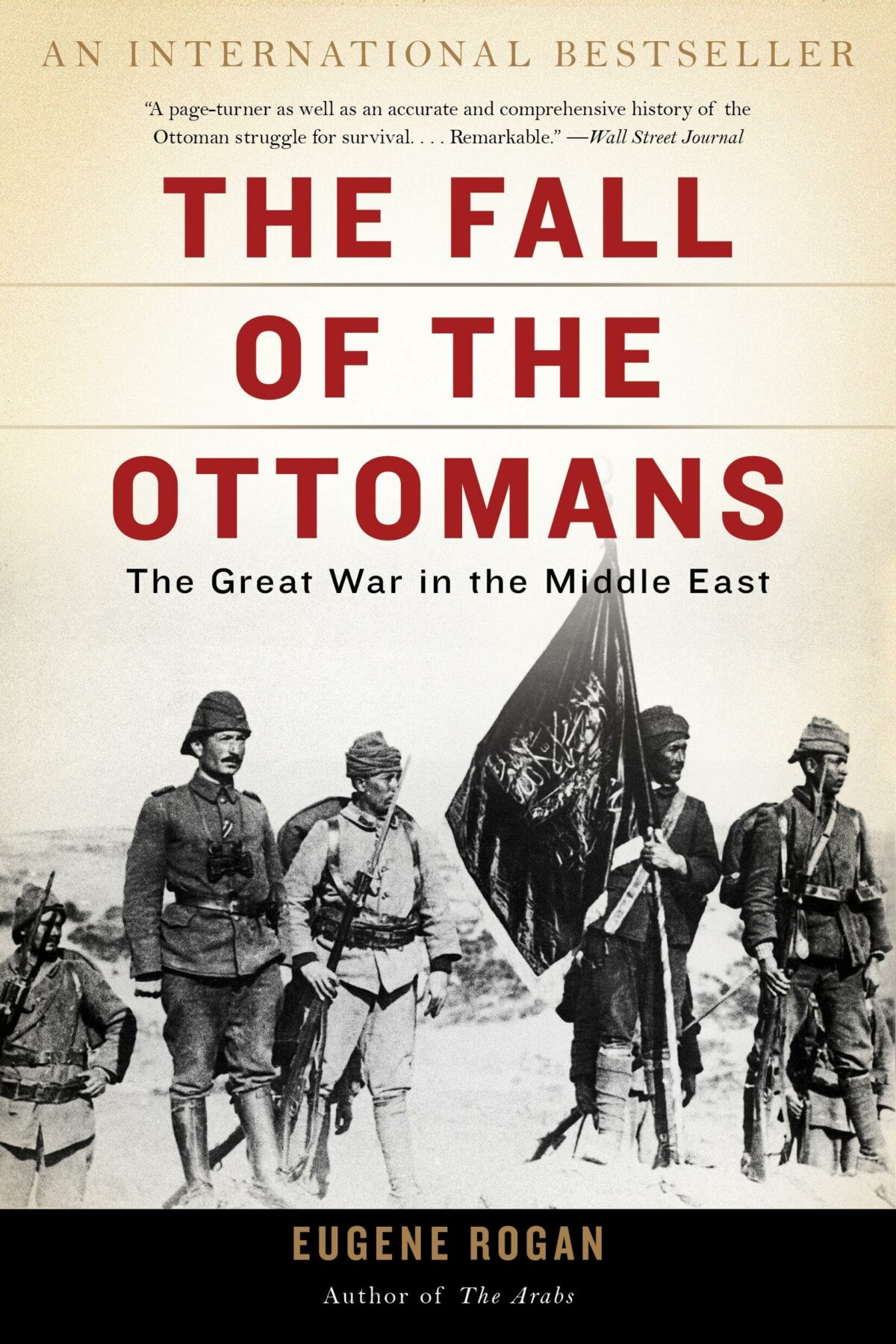
Rogan, Eugene. The Fall of the Ottomans: The Great War in the Middle East. New York: Basic Books, 2015.
The outcome and aftershocks of the First World War were transformative for the globe, not least in the Middle East as the centuries-old Ottoman Empire collapsed and was replaced with an artificial patchwork of states more designed for European imperial aggrandizement than stable nation building or popular sovereignty. Indeed, the Great War has become something of a minor specialization of mine due not only to the participation of Great Britain as a combatant but for the vital interplay of the conflict with that empire both in causes and consequences. Perhaps understandably, then, most of the material I’ve encountered has either actively or passively prioritized the viewpoint of the Allies in general and Britain in particular. Eugene Rogan’s attempt to invert that paradigm and restore the Ottoman Empire to the center of the Near Eastern theater of the war was exactly the corrective I needed.
As it so happens, The Fall of the Ottomans is the mirror image of one of the first monographs I ever reviewed here on Concerning History, Rob Johnson’s almost-identically titled The Great War and the MIddle East. While Johnson delivered a hyper-detailed (yet refreshingly concise) account of military campaigns, Rogan takes a broader, more political approach befitting a more public-facing history. As so many books do these days, The Fall of the Ottomans treats readers to an overview of the decades of Ottoman history preceding its topic, and this background information gratifyingly provides a stronger throughline for Rogan’s narrative more so than other similar works. Indeed, not only the structure and inner workings of the Ottoman government but the diplomatic and geopolitical decisions of that government, not to mention the individual strengths, biases, and failings of the major figures that comprised it for the duration of the war. The logic of Ottoman entry into the war as well as the many campaigns across Anatolia, Mesopotamia, Egypt, and Palestine are clearly laid out, if absent any in-depth accounts of maneuvering or any particular battle’s tactical course. That said, one particular topic is examined in highly specific detail: the Armenian genocide. In a way I’ve never seen before, Rogan both paints a complex, nuanced picture of how Ottoman authorities did have reason to fear certain Armenian nationalist movements that were sympathetic to Russia and could act as a fifth column while also conclusively demonstrating that the ensuing response was not simply a careless and inhumane deportation but a systematically engineered genocide, with officials on the ground receiving written orders to conduct the forced evacuation of Armenian civilians to Syria while simultaneously receiving verbal orders to eliminate every one of those same refugees en route.
The biggest weakness in Rogan’s work is that it simply…ends, right when the premise of his title seems to be gathering steam. The Fall of the Ottomans does a fantastic job of demonstrating how this unstable, outdated empire proved surprisingly resilient in its waging of the First World War. The only front on which it proved unequivocally victorious was the campaign for the Dardanelles in 1915-6, right on the doorstep of the capital, but while every other campaign ended in defeat or ignominious rout, Ottoman institutions and personnel proved just flexible and sturdy enough to survive. At the time of the Paris Peace Conference, then, the Ottoman regime still very much stood—contrary to the fate of tsarist Russia, the German Kaiserreich, or, soon, Austria-Hungary. It was in fact the post-war invasions of Anatolia at the hands of Italy and Greece that drove the final dissolution of the empire and its transformation into the nation-state of Turkey when Ottoman authorities made the fateful decision to knuckle under to the Allies and not support Mustafa Kemal in his defense of the Turkish heartland. What’s more, Rogan covers these campaigns with only the briefest of summaries in his conclusion. The result is an excellent work of history partially neutered right at the finish line.
Despite this flaw, though, The Fall of the Ottomans proved to be exactly the highly engaging, readable history I was hoping it would be. Any effort to restore necessary perspective to a topic and relating events from unheard perspectives is an admirable one, If only for Rogan’s outstanding section on the Armenian Genocide, it is well worth a try.